So Untalented, He Was Accused of Being AI
A man so terrible at drawing, millions have accused him of being ChatGPT.

Hi,
I'm so happy, you lot.
Webworm Live 2026 in New Zealand is almost sold out – there are just a few tickets left upstairs. This means so much to me – thank you.
Same thing with next week's Tickled screenings in New York – thank you.
Now – onto today's Webworm: Imagine you're so terrible at something, millions come for your throat, accusing you of being AI. How do you defend yourself from a world so utterly warped by AI slop, they can't differentiate it from plain-old human slop?
After all, humans are the sloppiest of them all.
Dylan Reeve has today's Webworm.
So Untalented, He Was Accused of Being AI
by Dylan Reeve.
On Monday evening, a roofer from Southland posted an image to his Facebook page riffing on the frustration many people feel with modern social media (and, increasingly, real life) where they are seemingly bombarded with AI-generated ‘slop’ ads for every other business they encounter.
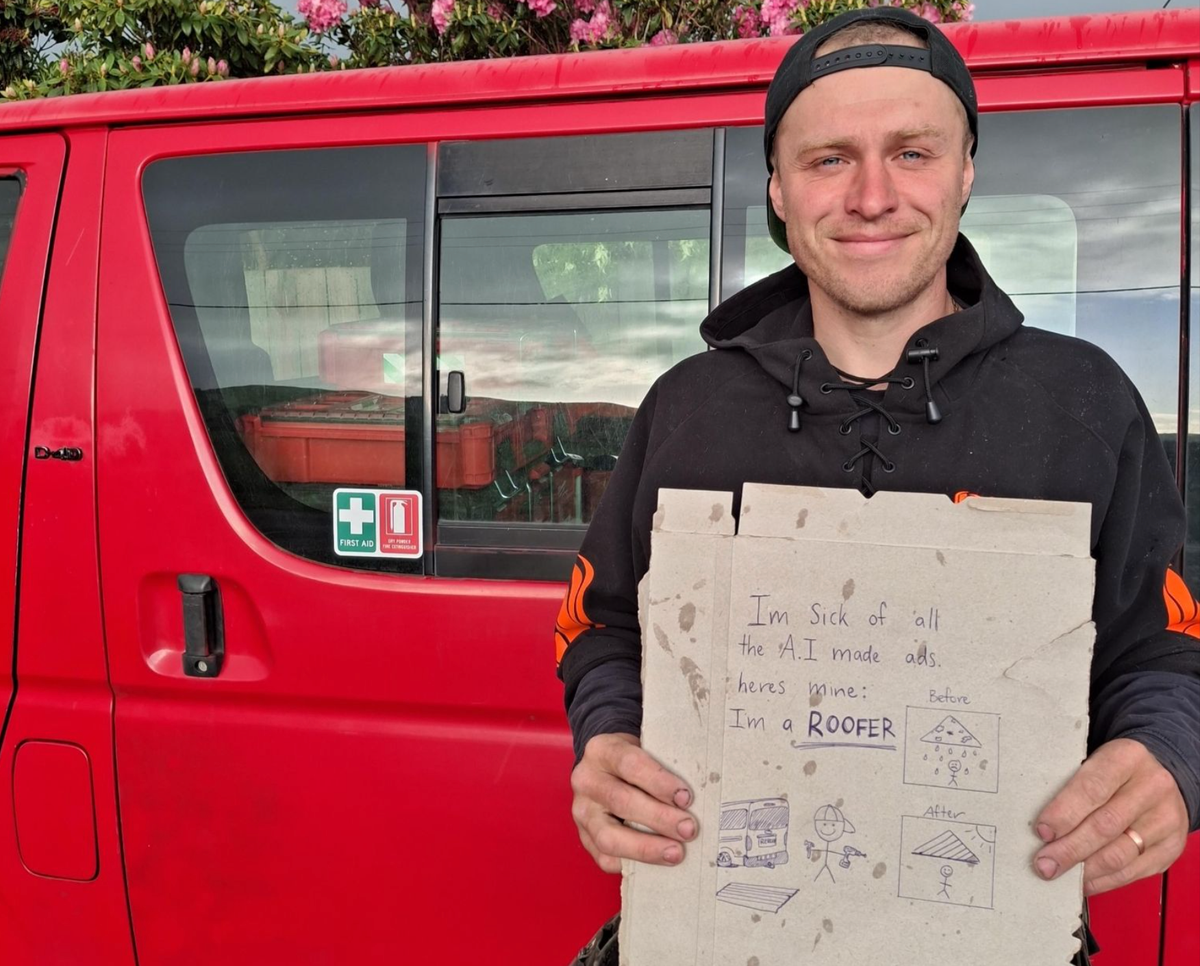
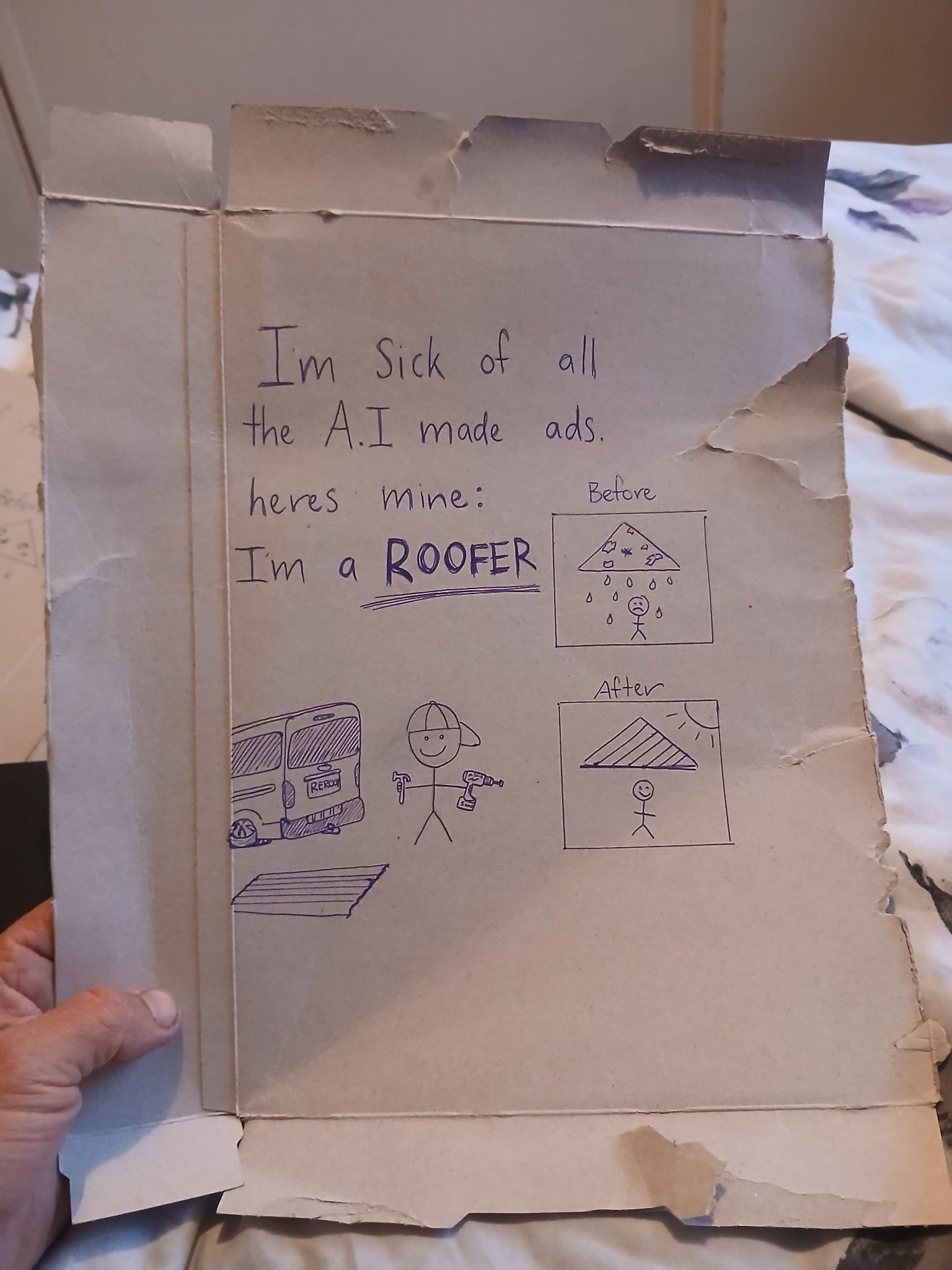
“I’m sick of all the A.I. made ads. Here’s mine: I’m a roofer” read the seemingly hand-drawn promotional image, showing a before and after of a leaky roof and a nice new one, alongside a smiling tradie and his van:
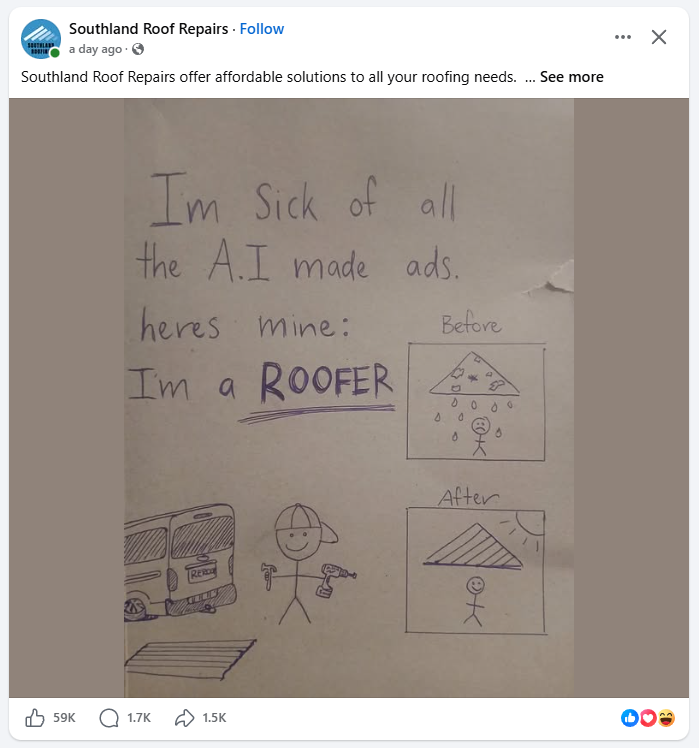
It went viral quickly! The original post was widely shared on Facebook, and screenshots quickly found their way onto other pages and platforms. But to many users it all looked a bit, well, AI.
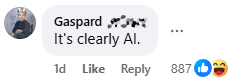
It was, honestly, my first reaction too – and it seemed like that latent distrust of anything online was lurking just beneath the surface for a significant proportion of those commenting.
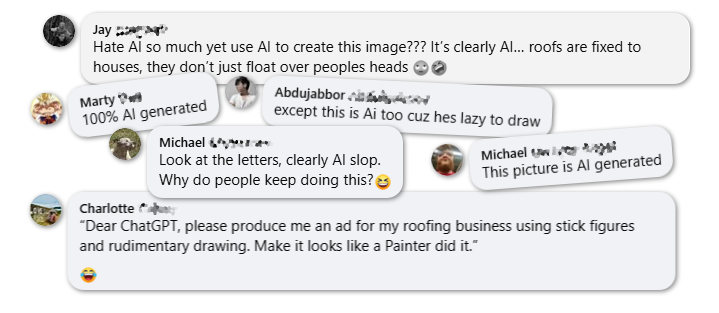
Those suspicious users were quick to deliver their proof, with nearly identical posts from other businesses demonstrating that this was just one more in a long long of AI templates allowing lazy companies to bombard social media.
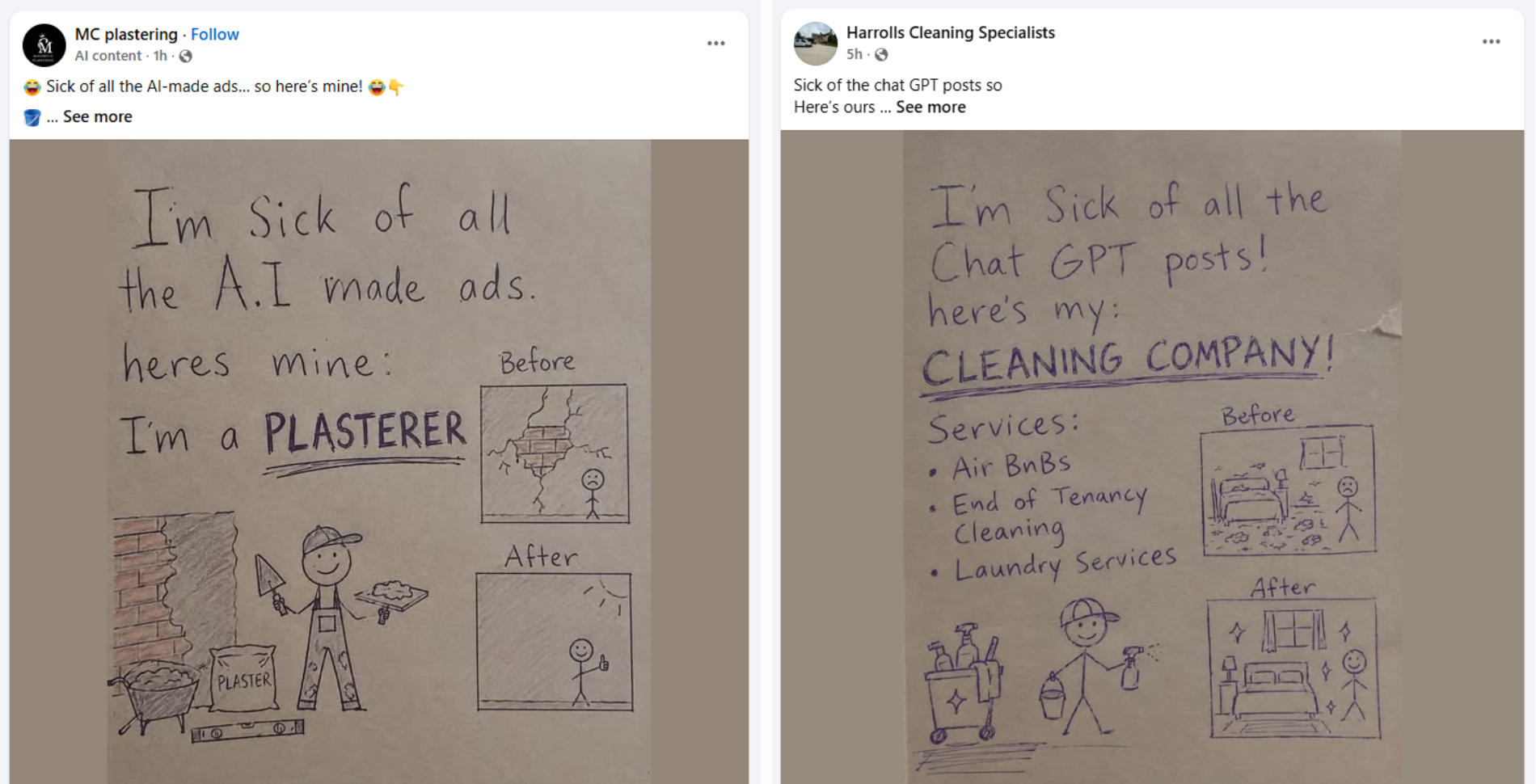
It seemed pretty open and shut to many of the thousands of commenters. For some the whole experience delivered a substantial hit to their overall sense of trust.
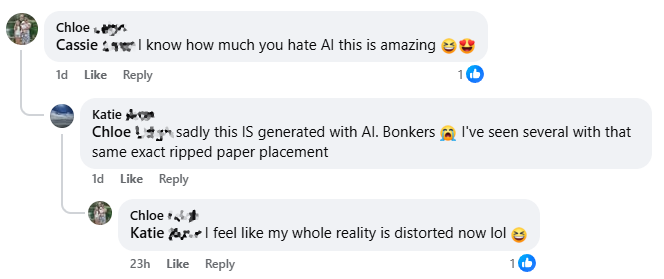
But there was just one thing nagging at me: None of the other examples seemed to be older than the one posted by Southland Roof Repairs. In fact, they had all appeared after that post was already going viral on Facebook.
When checked with SynthID AI-watermark tools, the near identical examples that I found returned a positive result for having been generated with OpenAI tools. The same wasn’t true for Southland Roof Repairs’ version, which showed no AI watermarks.
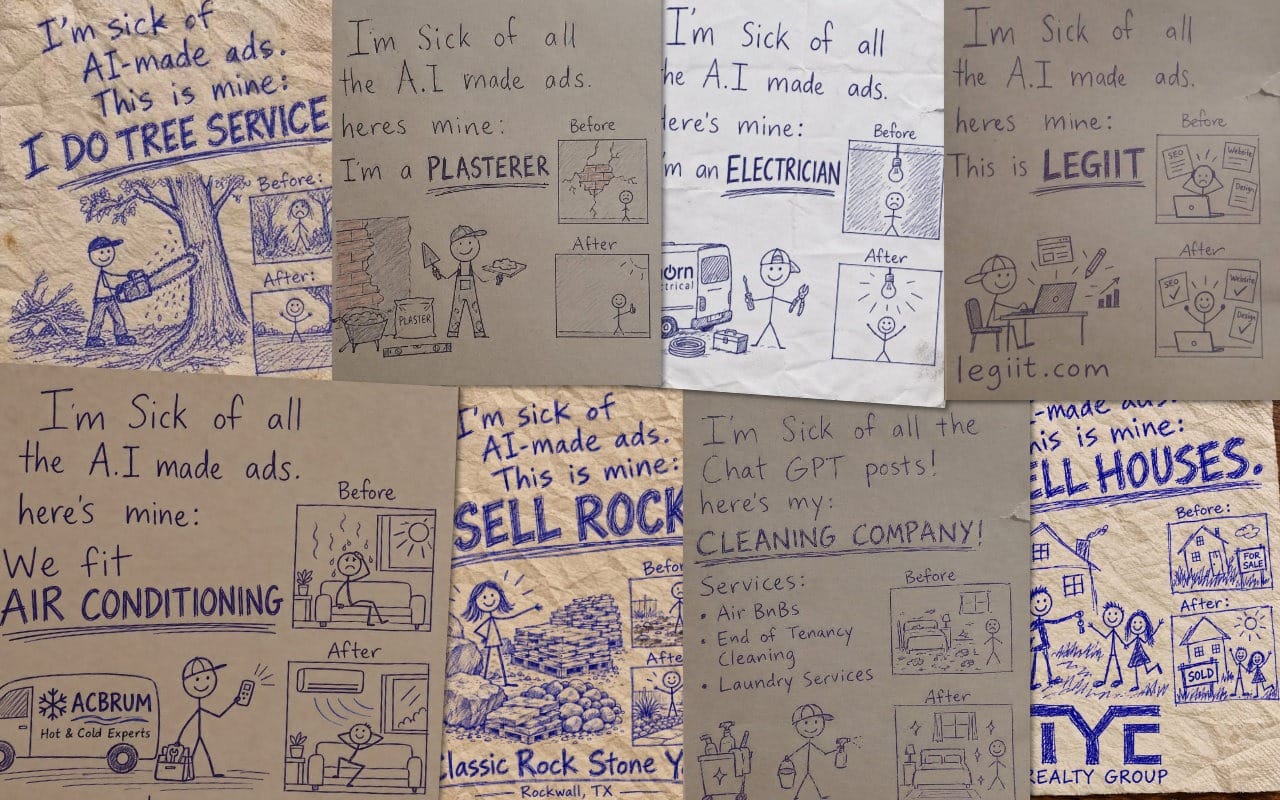
I did note there were other, older, examples of the same idea, which were clearly AI generated:
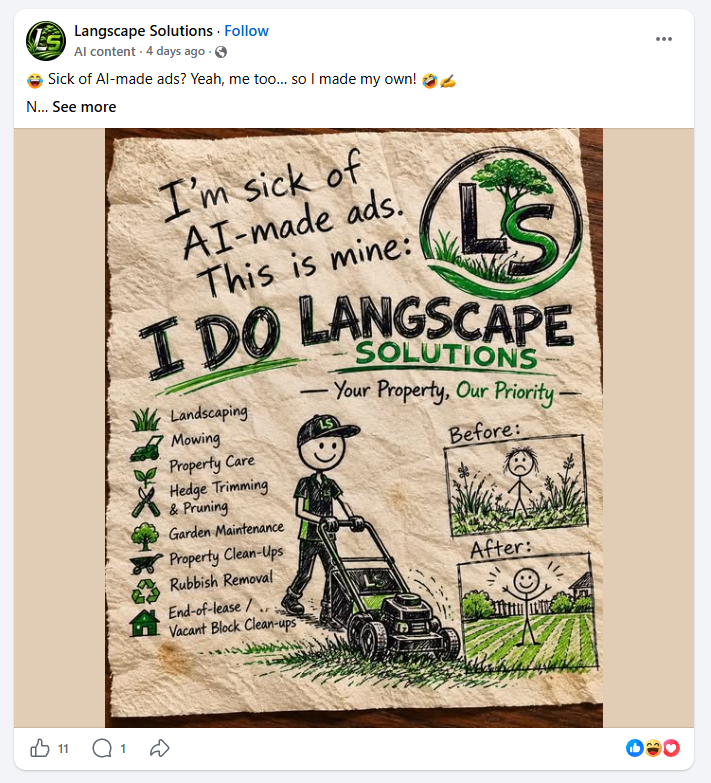
But I wanted to know more, so I reached out to Anton, from Southland Roof Repairs, to find out how it all went down – and confirm my assessment that the image he posted was a real drawing.
Spoiler: I’m convinced. It’s a real, physical drawing, not something generated by AI.
We started with the very first point — the underlying concept that a handwritten promotional image complaining about AI isn’t new.
“Yeah, so it wasn’t really my idea,” Anton conceded when I reached him by phone at the end of a presumably long day fixing roofs. “I’d seen something similar posted about a week ago, and I thought ‘oh man, that’s such a cool idea, I’m going to put my own twist on it!’”
But on Monday evening when it came time to create his masterpiece, he was immediately hamstrung by a common problem in our digital age. “I looked around the house but couldn’t find any paper to draw on… so I think, ‘OK, fuck it’ and grabbed an old cereal box then drew my wee stick-figure guy!”
I was already aware of Anton’s unorthodox medium choice. Under attack from AI sceptics in his comments, he’d posted two photos of the box already, to provide proof of his work.
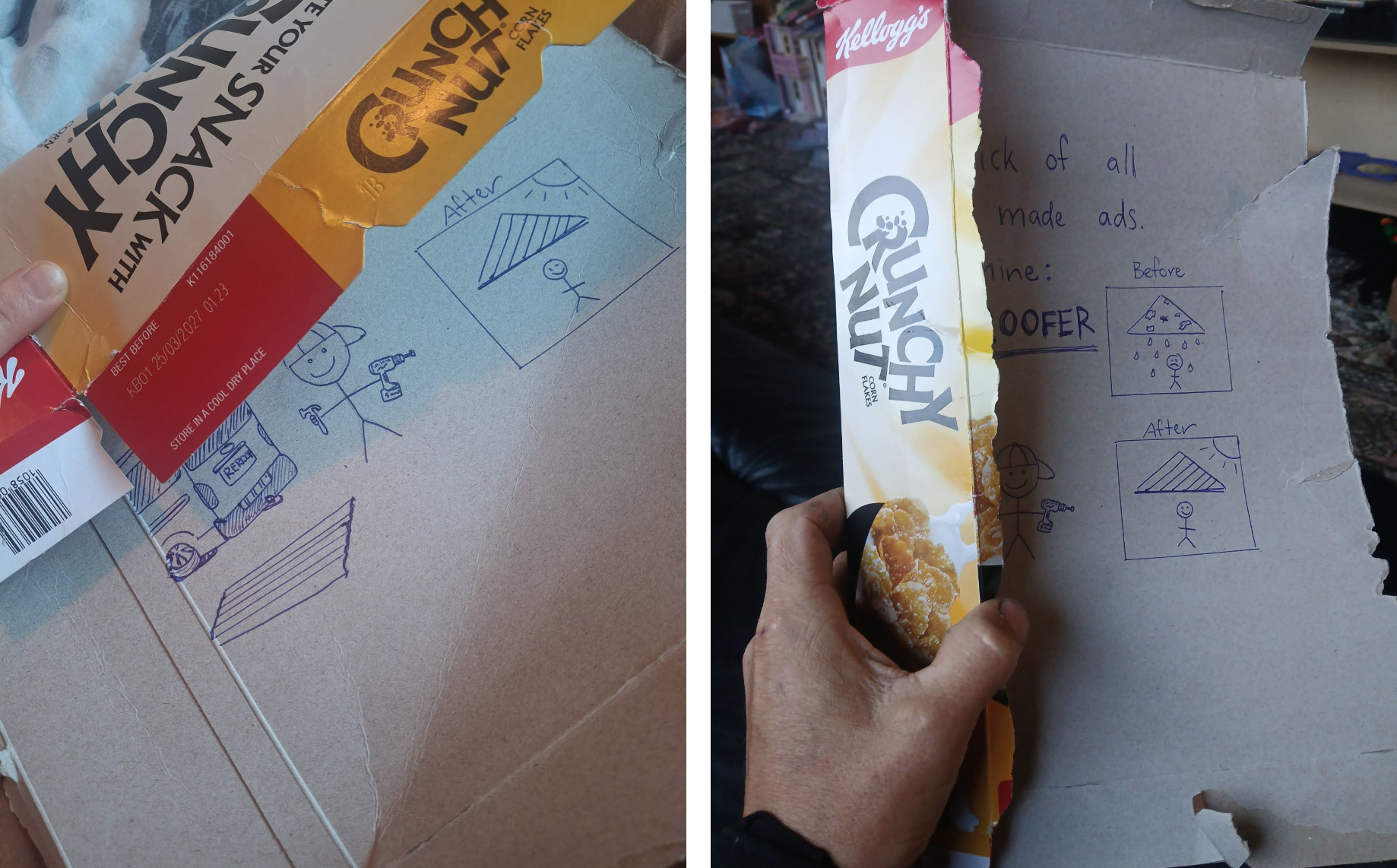
It was actually these images that had convinced me I was looking at a real photo in the original post. Sure, he could have Photoshopped an AI drawing onto a photograph of the cereal box, or even had AI do that too. But a really close look at all three images together showed a lot of consistencies — something that generative AI isn’t good at, and human artists often overlook
Also, all three of the images got a clean bill of health from the AI-watermark tool.
So, back to Anton’s story: Having drawn up his little promo image, he snapped a photo and chucked it on his business Facebook page, then carried on with his night. It started slow — a handful of likes, and a few comments from among the 50ish people who already followed the page.
But then things started to change. The next day it had clearly captured a bit of notice from users a little further outside his normal sphere, but it was later that night that it really kicked off. “My partner and I are both admins on the page,” Anton explained, but only his partner had allowed notifications for the page, and her phone was lighting up!
“It was just like, ding, ding, ding, ding, ding… I think it was reaching a whole heap of Australians first, and then, all of a sudden, it went worldwide.”
The Facebook post of a roofer from the bottom of New Zealand’s South Island was suddenly going fully viral.
By the time I spoke to Anton, the post had received more than 7 million views — more than the population of New Zealand — had thousands of shares on Facebook, and was attracting new comments by the minute (many of which were accusing it of being AI).
Anton had seen a small influx of work, and a big influx of attention.
His viral post had captured a feeling of exhaustion and frustration that so many can relate to with the flood of AI-generated ‘slop’ and then, ironically, that very viral attention had sent others off to generate their own AI rip-offs of his work.
Some examples of the AI lookalikes even showed the same small rip, demonstrating that they’d been created directly from Anton’s photo as the source.
When I spoke to Anton, he’d just been through yet another hump on the unexpected rollercoaster of viral attention — his Facebook page had vanished, and he had no idea why. His assumption was that it had been hacked and deleted, but trying to get answers from Facebook was just another step into full-on AI frustration, as he was unable to talk to a real human, just AI bots. “You’re just arguing with a robot! What can you do?”
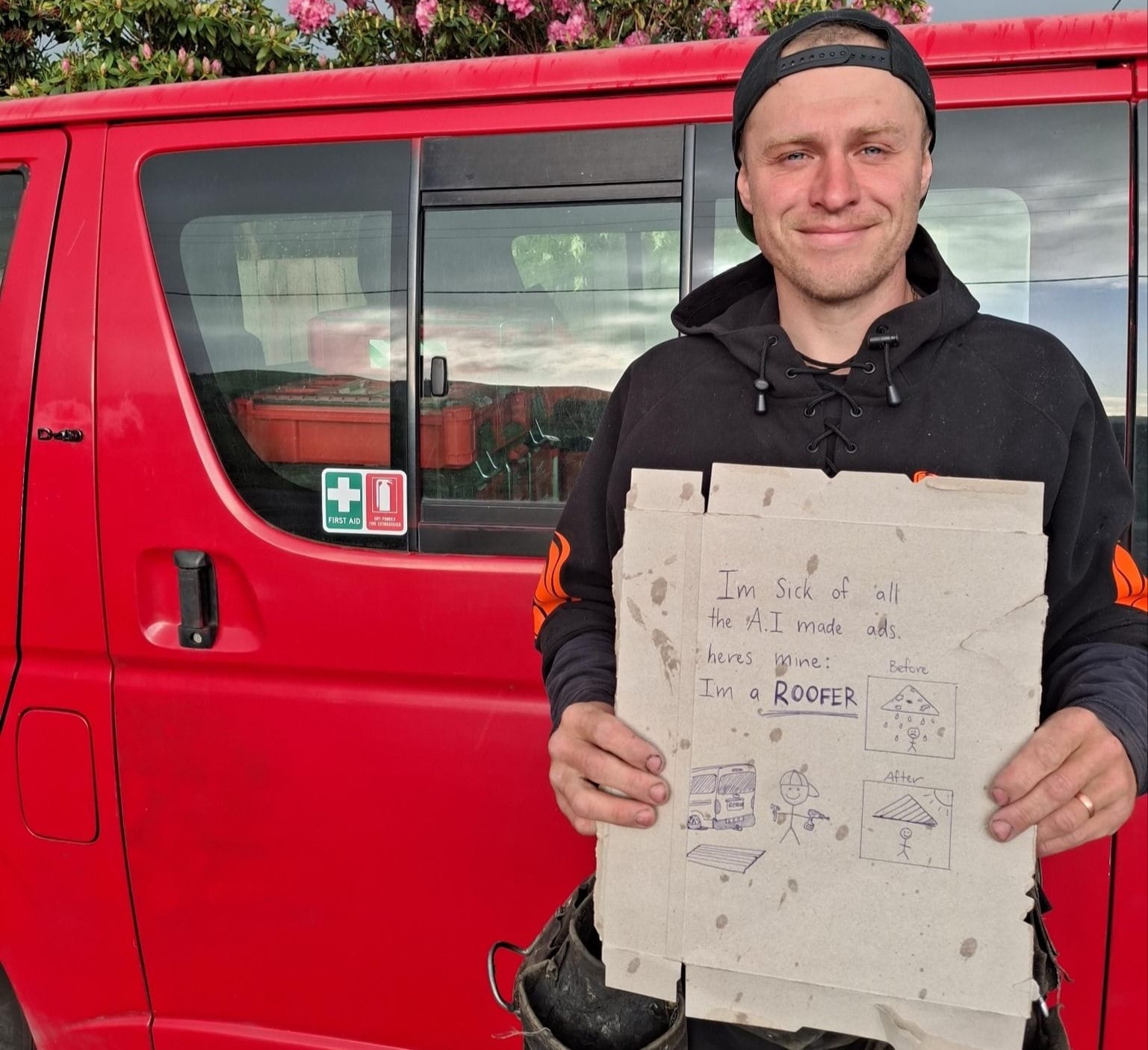
As we ended our call I did want just one more little reassurance that I wasn’t being fooled by AI, so I asked Anton to send me a fresh photo of the drawing, straight from his phone camera.
Less than two minutes after ending the call I received the email. A photo timestamped just a minute earlier.
I put it through a few tests, and it passed! The photo had fully consistent image metadata showing it was taken exactly when it was claimed, with a Samsung Galaxy XCover7 (a phone I’d never heard of before). And once again, a clean bill of health from AI-watermark tools.
A little while later as I drafted this story one more surprise — the Facebook page was back online. No clear indication of what had happened, or why. But the post was back, and soon enough it was gathering new likes, as well as those comments from sceptics, all too ready to believe it was just more AI slop.
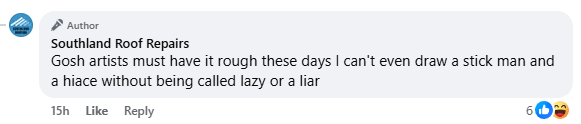
Now, after this whole experience, a Kiwi roofer is unexpectedly in the same situation that many artists now find themselves.
-Dylan Reeve.